
The American Civil War is one of the most important conflicts in the history of military technology. It was fought at a pivotal moment — after the Industrial Revolution had transformed manufacturing capacity and weapons design but before military tactics had fully adapted to the new realities of industrialized killing. The result was a war in which the weapons were dramatically more lethal than anything previous generations of soldiers had faced, but the tactics were still largely derived from an earlier, less deadly era. This mismatch between technology and tactics helps explain the catastrophic casualty rates that made the Civil War so devastatin.
The standard infantry weapon of both Union and Confederate soldiers was the rifled musket — most commonly the Springfield Model 1861 on the Union side and its near-identical Confederate counterpart, the Richmond Rifle Musket, on the Confederate side. Hundreds of thousands of Springfield 1861s were produced during the war, making it the most widely used military rifle in American history up to that time.
What made the rifled musket so revolutionary — and so lethal — compared to its predecessor, the smoothbore musket, was the combination of rifling (spiral grooves cut into the barrel that imparted a stabilizing spin to the bullet) and the Minié ball (a soft lead conical bullet that expanded upon firing to engage the rifling). This combination dramatically increased both the accuracy and the effective range of infantry weapons.
A smoothbore musket was effective at perhaps 50-75 yards. A Springfield rifle was accurate at up to 500 yards and lethal at considerably further range. This was a five to ten times increase in effective range — and it had profound implications for infantry tactics that commanders were painfully slow to recognize. Tactics designed for smoothbore weapons — massed frontal assaults at close range, standing in neat lines — produced catastrophic casualties when applied against rifled weapons, as the battles of Fredericksburg, Gettysburg, and Cold Harbor demonstrated repeatedly.
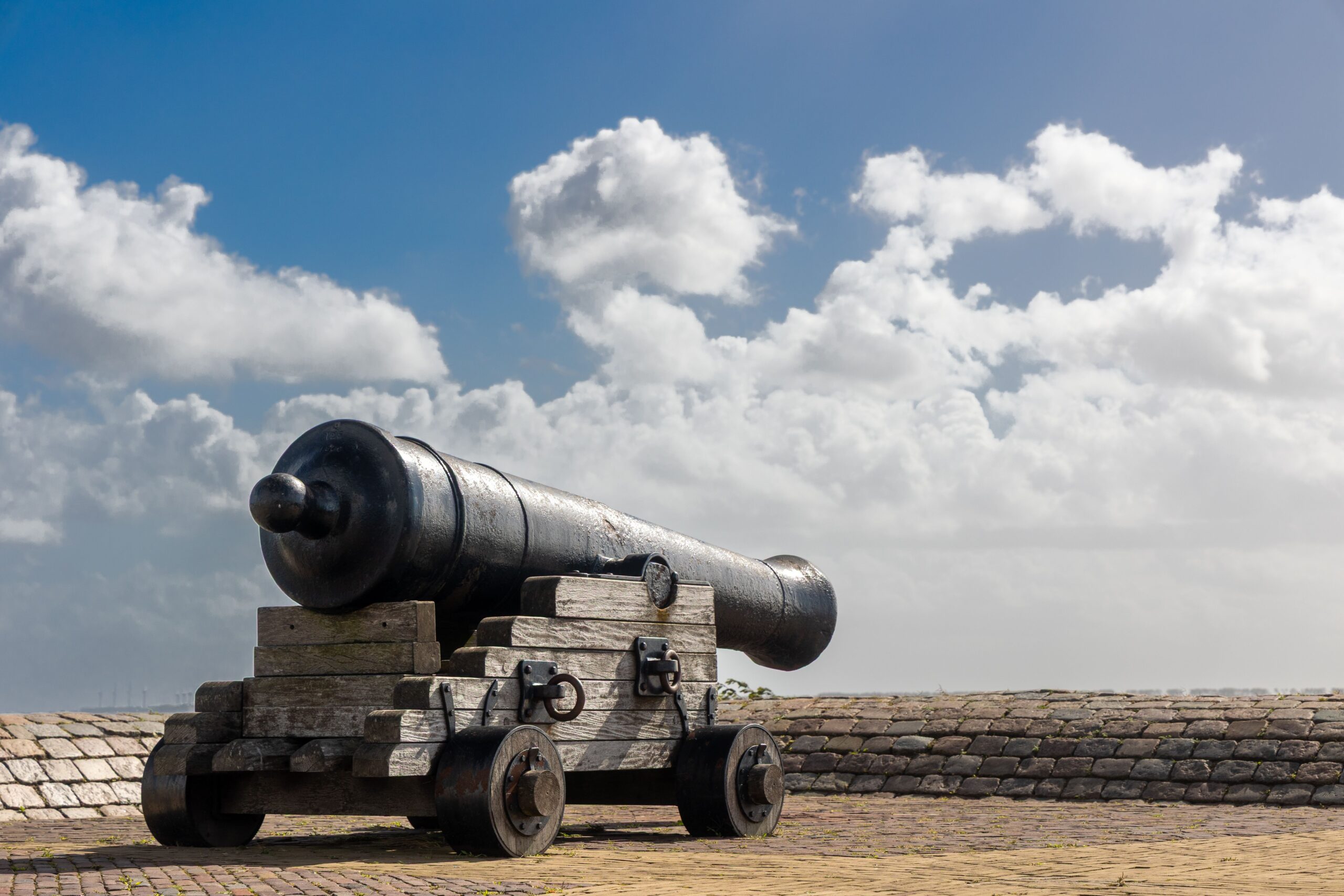
Artillery caused approximately 60 percent of Civil War battlefield casualties, making it by far the war’s most lethal weapon system. Civil War artillery was itself in technological transition — with smoothbore cannon and rifled artillery pieces serving side by side.
The most common Union field artillery piece was the Model 1857 Napoleon, a smoothbore bronze cannon that fired a 12-pound projectile and was devastatingly effective at close range with canister shot — tin canisters filled with iron balls that essentially turned the cannon into a giant shotgun at ranges under 400 yards.
Rifled artillery pieces — including the Parrott rifle and the 3-inch Ordnance Rifle — had greater range and accuracy than smoothbores, effective at distances of 2,000 yards or more. They fired solid shot, explosive shells, and elongated bolts depending on the target and situation.
Artillery projectiles came in several varieties: solid shot for destroying structures and artillery pieces; explosive shell, which burst on contact or via time fuze; spherical case shot (shrapnel), which burst in the air above troops; and canister, the close-range anti-personnel round that proved most lethal when infantry attacks reached artillery positions.
The Civil War saw the first significant military use of repeating firearms — weapons capable of firing multiple rounds without reloading. The most famous was the Henry rifle, a lever-action repeating rifle with a 16-round tubular magazine that allowed a trained shooter to fire up to 28 rounds per minute. The Spencer repeating rifle, adopted by Union cavalry, held seven rounds in a tubular magazine in the stock.
These weapons gave the soldiers who carried them — primarily Union cavalry — a devastating firepower advantage in engagements where they could be deployed. Confederate soldiers who faced Union cavalry armed with Spencer carbines frequently reported the terrifying experience of being outgunned in a way they could not counter with their single-shot weapons.
The Confederate army was unable to manufacture repeating weapons in significant numbers due to its limited industrial capacity, and this firepower disadvantage became increasingly significant as the war progressed.
The Civil War revolutionized naval warfare with the introduction of ironclad warships. The famous battle between the USS Monitor and CSS Virginia (Merrimack) on March 9, 1862 — the first combat between iron-armored warships — made every wooden warship in the world immediately obsolete.
The Monitor’s rotating gun turret — which could direct its guns in any direction — was itself a revolutionary naval weapon innovation. The Confederate Virginia, cobbled together on the hull of the captured USS Merrimack, demonstrated that ironclad vessels were essentially impervious to the traditional naval weapons of wooden warships.
Naval mines — then called “torpedoes” — were extensively used by the Confederacy to defend its harbors and rivers. They sank more Union warships during the war than any other cause, and the phrase “Damn the torpedoes, full speed ahead!” — attributed to Admiral Farragut at the Battle of Mobile Bay — reflects their psychological impact on Union naval commanders.
While firearms dominated Civil War combat, officers and cavalry still carried swords, though their primary use by the war’s middle years was more ceremonial than tactical. Cavalry saber charges occurred throughout the war, particularly in the early conflict before cavalry increasingly adopted the tactics of mounted infantry — riding to a position and fighting dismounted with carbines.
Pistols — both single-shot percussion pistols and the new Colt Army and Navy revolvers — were carried by officers, cavalry, and some specialized troops. The Colt Navy Revolver, a six-shot percussion weapon, was particularly widely used.
The weapons of the Civil War represented a bridge between the classical era of military technology and the modern industrial age of mass destruction. Their combination of extended range, rapid production capability, and tactical versatility made the Civil War’s battlefields enormously lethal environments — and the experience of men like Horace “Three Tooth” Langham, navigating that environment with only raw courage and the bonds of brotherhood to sustain them, is what Cameron Crisp’s Three Tooth Confederate brings so vividly to life.