
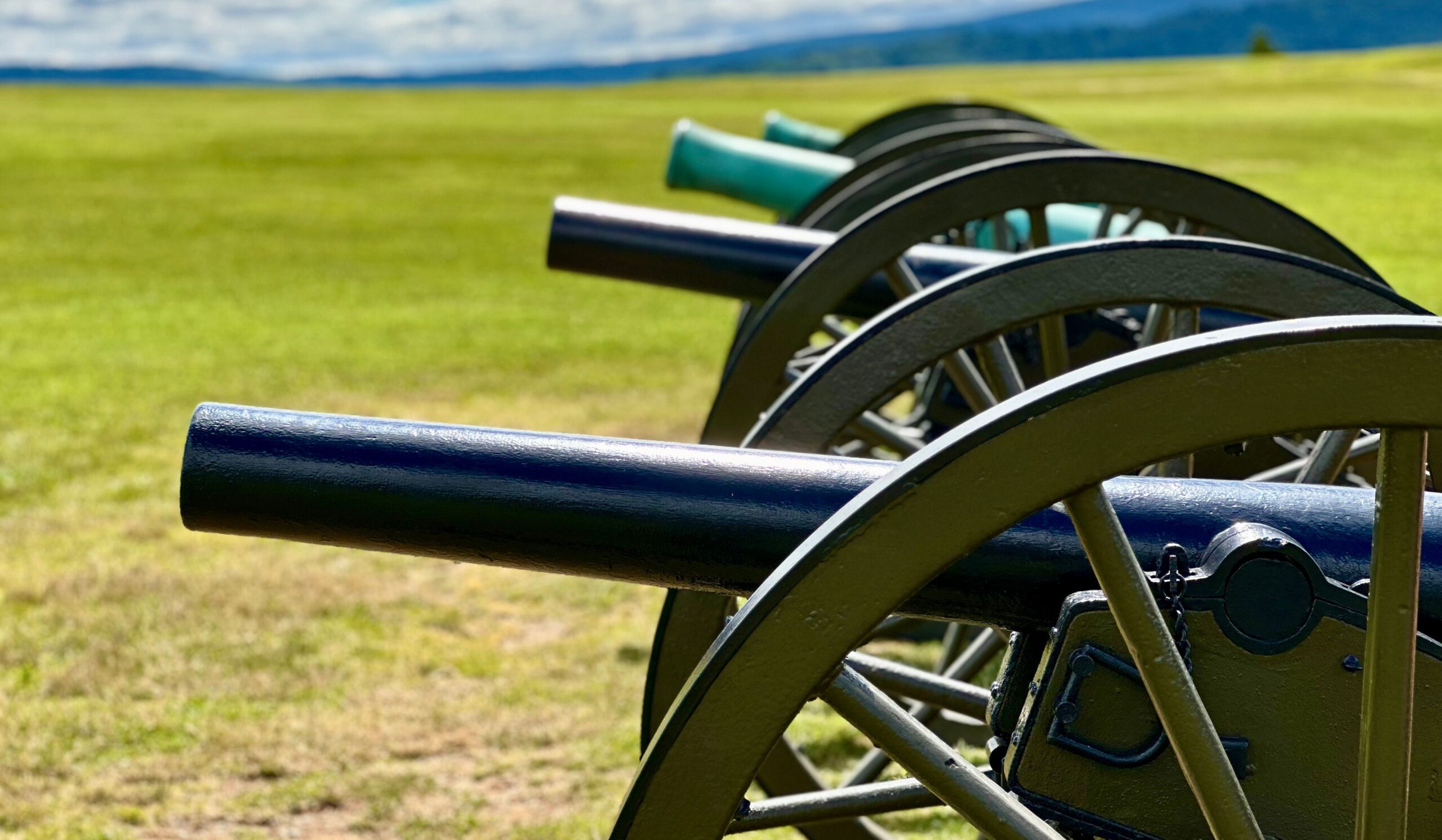
In the long and terrible catalogue of American Civil War battles, one day stands apart for the sheer, concentrated scale of its violence: September 17, 1862, the Battle of Antietam, fought near Sharpsburg, Maryland along the banks of Antietam Creek. Known in Confederate accounts as the Battle of Sharpsburg, this engagement produced more American casualties in a single day than any other battle in the nation’s history – before or since.
Antietam is known for many things: the catastrophic casualty count, the desperate fighting across the Cornfield, the Sunken Road, and Burnside Bridge, the strategic consequences that shaped the remainder of the war, and above all, the human tragedy of a day when roughly 22,700 Americans were killed, wounded, or reported missing in the space of twelve hours.
For Cameron Crisp’s Three Tooth Confederate, Sharpsburg – the Confederate name for Antietam – is one of the novel’s central settings, where young Horace “Three Tooth” Langham’s journey through the war reaches some of its most intense moments.
The Battle of Antietam was the culmination of General Robert E. Lee’s first invasion of the North, known as the Maryland Campaign. Following a string of Confederate victories in Virginia – including the Second Battle of Bull Run in late August 1862 – Lee made the bold decision to cross the Potomac River into Maryland in early September.
Lee’s reasons for the invasion were multiple: he hoped to relieve war-weary Virginia of the burden of supporting his army during the harvest season; he wanted to win a major victory on Northern soil that might convince Britain and France to recognize the Confederacy and potentially intervene; and he hoped to influence the Northern congressional elections of 1862 by demonstrating that the Union could not win the war.
The campaign immediately ran into difficulties. A copy of Lee’s operational orders – Special Orders No. 191 – was lost and found by a Union soldier, giving Union General George McClellan an extraordinary intelligence windfall: knowledge of exactly how Lee had divided his army to deal with the Union garrison at Harpers Ferry. McClellan moved faster than usual, though historians have long debated whether he moved as fast as the intelligence opportunity warranted.
The fighting at Antietam on September 17 took place in three distinct phases across the same day, each concentrated in different sectors of the battlefield.
The morning phase focused on the northern part of the field, centered on the Miller Cornfield, where Union forces under Major General Joseph Hooker attacked Confederate forces commanded by Stonewall Jackson. The fighting in the Cornfield was among the most intense of the entire war – units were shattered in minutes, the cornfield changed hands multiple times, and both sides suffered catastrophic casualties. By one account, the Cornfield was crossed by Union and Confederate forces no fewer than fifteen times in the course of the morning.
The midday phase shifted to the center of the Confederate line, where Confederate soldiers had sheltered in a sunken farm road that provided natural cover. The fighting along “Bloody Lane,” as it became known, was a prolonged, murderous engagement in which the road itself was eventually filled with Confederate dead. When Union forces finally breached the Confederate center in the early afternoon, a determined push might have destroyed Lee’s army – but McClellan’s characteristic caution prevented him from committing his reserves for the decisive stroke.
The afternoon phase occurred on the Confederate right, where Union General Ambrose Burnside attempted to force a crossing of Antietam Creek at a stone bridge that would bear his name. Confederate defenders held the bridge for hours with a relatively small force, inflicting heavy casualties on Union attackers. When Burnside finally crossed and threatened to turn the Confederate flank, the timely arrival of A.P. Hill’s Confederate division from Harpers Ferry – where it had just completed the capture of the Union garrison – drove Burnside’s forces back and stabilized the Confederate line as darkness fell.
The numbers from Antietam are staggering even by the brutal standards of Civil War combat. Total casualties – killed, wounded, and missing – numbered approximately 22,700: roughly 12,400 Union and 10,300 Confederate. More Americans died or were wounded in that single day than in the Revolutionary War and the War of 1812 combined.
For individual units, the carnage was almost incomprehensible. The 1st Texas Infantry entered the battle with 226 men and lost 186 of them – an 82 percent casualty rate – in less than twenty minutes in the Cornfield. Other units on both sides suffered similar catastrophic losses in specific engagements throughout the day.
Despite the enormous bloodshed, the battle was tactically inconclusive. Lee withdrew his army back to Virginia the following night, and McClellan, to Lincoln’s intense frustration, failed to pursue aggressively. But strategically, the battle was an important Union success, because it stopped Lee’s invasion and gave Lincoln the victory he needed to issue the Emancipation Proclamation.
Lincoln had prepared the proclamation weeks earlier but had been advised to wait for a Union military success before issuing it, to prevent it from appearing to be an act of desperation. Antietam provided that success. Five days after the battle, on September 22, 1862, Lincoln issued the preliminary Emancipation Proclamation, declaring that enslaved people in Confederate states would be free as of January 1, 1863.
The proclamation transformed the war’s international dimensions: Britain and France, both of which had been considering recognizing the Confederacy, could not now support the slave-holding side in a war that had formally become a war for freedom.
The Battle of Antietam is known for the catastrophic scale of human suffering it produced in a single day, for the desperate fighting in the Cornfield, Bloody Lane, and at Burnside Bridge, and for the strategic consequences – particularly the Emancipation Proclamation – that made it one of the war’s pivotal events. For anyone seeking to understand the Civil War in its full human and strategic dimensions, Antietam is essential territory.